Stone worktops involve more decisions than most people expect.
You’ve chosen your material – granite, marble, quartz – but then come questions about thickness and edges.
Twenty millimetres or thirty? Pencil edge or ogee? These choices affect how your worktop looks, what it costs, and how it performs.
Understanding your options helps you make decisions that suit your kitchen, your budget and how you use the space. Here’s what you need to know about stone thickness and edge profiles.
Understanding stone thickness: 20mm vs 30mm
Worktop thickness comes down to two standard options: 20mm or 30mm. Both work well, but they suit different situations and budgets.
20mm thickness
The most common choice for residential kitchens. It’s structurally sound, costs less than thicker options, and works with most edge profiles. For everyday use in typical kitchens, 20mm stone performs perfectly well. It handles heat well (though trivets recommended), daily prep work, and general wear without issues.
30mm thickness
Fffers a more substantial look and feel. The extra weight and presence suit larger kitchens or spaces. The additional thickness also allows for more elaborate edge profiles that need extra material to work with.
At Landford Stone, we stock both thicknesses across our range of slabs and can advise on the appropriate use of either option.
Popular edge profiles explained
Edge profiles significantly affect your worktop’s final appearance. From simple to ornate, each style creates a different look and feel.
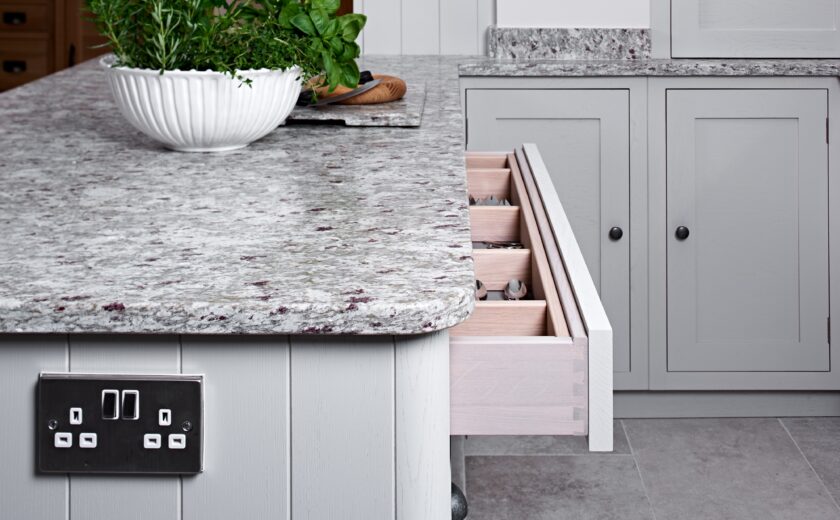
- Pencil Edge: A slightly rounded edge that’s practical and timeless. Works well with both traditional and contemporary kitchens. Easy to clean and comfortable to lean against.
- Square Edge: Clean, sharp lines that suit modern, minimalist kitchens. Creates a crisp, geometric look. Requires careful handling during installation as corners can chip if knocked hard.
- Bevel Edge: A chamfered angle along the top edge that adds subtle detail without going ornate. Popular for contemporary spaces that want something beyond basic but not overly decorative.
- Ogee Edge: A classical S-shaped curve that brings elegance and traditional style. Suits period properties or kitchens with more ornate cabinetry.
- Bullnose Edge: A fully rounded edge that’s soft and safe, particularly useful in family homes. Comfortable to lean against and less likely to cause injury from sharp corners.
How edge profiles affect cost
In short, simple edges cost less to fabricate. Pencil and square edges involve minimal cutting and shaping, keeping labour costs down. More elaborate profiles like ogee require additional time and precision, which increases the final price.
Here’s a short guide to what you can expect:
- Basic Edges (Pencil, Square): Standard pricing, quick fabrication, work with any thickness
- Mid-Range Edges (Bevel, Bullnose): Moderate additional cost, suit most kitchens, versatile thickness options
- Premium Edges (Ogee, Custom Profiles): Higher cost due to complexity, usually require 30mm thickness, suited to specific styles
This is flexible, however. Speak to us if you’re interested in more ornate edges, and we’ll talk you through the options.
Durability considerations
Thickness affects durability somewhat, though both 20mm and 30mm perform well in typical kitchens. Thicker stone has slightly more impact resistance, but proper installation and support matter more than thickness alone.
Be aware that sharp corners and delicate curves on square or ogee edges can naturally chip if struck hard. Conversely, rounded profiles like pencil or bullnose prove more forgiving with daily knocks and bumps.
Natural stones like granite and marble have different durability characteristics than engineered quartz, regardless of thickness. Granite typically handles impacts well. Marble is softer and more prone to scratching. Quartz offers consistent strength throughout.
Matching edges to your kitchen style
In terms of design, contemporary spaces often suit cleaner profiles – square, pencil, or bevel edges maintain the minimalist aesthetic. Traditional kitchens can feature more ornate options, such as ogee or detailed bullnose profiles.
Consider your cabinetry style, too. Shaker doors with simple lines pair well with pencil or bevel edges. More decorative cabinet doors can handle ogee or custom profiles without feeling overdone.
And here’s a final tip: If you lean against worktops whilst cooking, rounded edges prove more comfortable!
Making your decision
Choosing thickness and edge profiles comes down to balancing aesthetics, budget and practicality. Most homeowners find 20mm thickness with pencil or bevel edges offers excellent value and versatility. Those wanting a premium look or specific style might opt for 30mm with more elaborate profiles.
Visit our showroom at Landford Stone to see different thicknesses and edge profiles in person. Our team can discuss which options suit your kitchen style, budget and how you use the space.
Ready to choose your stone worktop? Contact us to discuss your project. We’re based in Salisbury, Wiltshire, and happy to guide you through all the options.