Choosing between natural and man-made stone for your worktops is challenging, as both confer their own advantages.
In the natural corner, we have granite, limestone, and marble, which bring brilliant character and timelessness. Man-made options like quartz and ceramic/porcelain offer consistency and lower maintenance.
Neither is universally “better” – it depends on your lifestyle, priorities and what matters most to you.
Here’s what you need to know about each option for busy homes.
Understanding natural stone
Natural stone is quarried, and therefore, unique, with variations in colour, veining and patterning. There are three core options here. Let’s take a look at each:
Granite
Granite is the workhorse of natural stones. Extremely hard and durable, it handles heat well and resists scratching better than most alternatives.
Patterns range from subtle speckling to bold veining. Requires sealing periodically to maintain stain resistance, but otherwise proves fairly low-maintenance.
Marble
Marble offers unparalleled elegance with its distinctive veining and soft, luminous appearance.
Softer than granite, it’s more prone to scratching and etching from acidic substances like lemon juice or wine. It typically needs more careful maintenance and regular sealing, but the upsides are obvious as it’s luxurious and beautiful.
Limestone
Limestone provides understated, natural beauty with softer, more uniform colouring.
Similar maintenance requirements to marble – so it needs sealing and careful handling. It works beautifully for flooring and feature walls, but requires consideration for high-traffic worktop use.
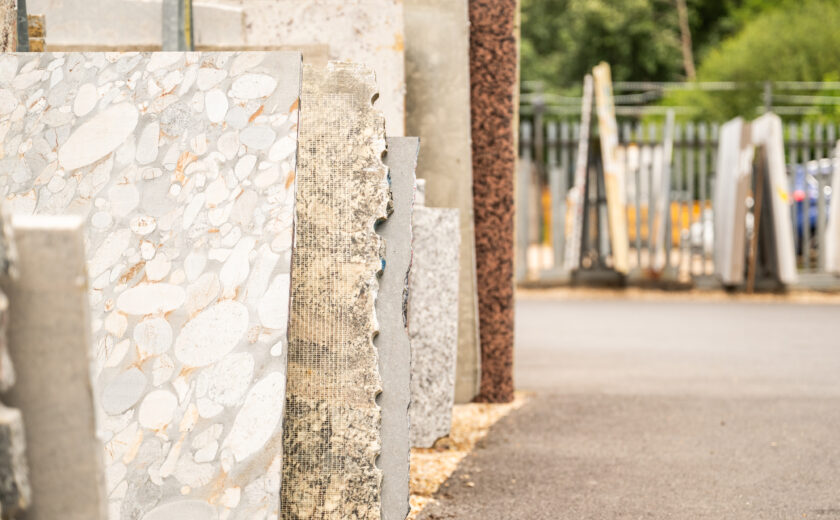
At Landford Stone, we stock over 2,800 different stone slabs, including extensive ranges of granite, marble and limestone. Each piece has unique characteristics you can hand-select at our Wiltshire yard.
Understanding man-made stone
Man-made stones are engineered products that combine natural materials with resins and pigments. There are two key options here:
Quartz
Quartz (like our Oyster Quartz range) consists of roughly 90–95% natural quartz combined with resins. This creates an extremely hard, non-porous surface that resists staining without sealing.
Available in consistent patterns and colours, from natural-looking designs to bold contemporary options. Handles daily kitchen use brilliantly – heat-resistant (though trivets recommended), scratch-resistant, and easy to clean.
Porcelain
Porcelain or ceramic (such as Oyster Ceramica) offers ultra-thin options with impressive durability. It’s non-porous, highly resistant to heat (though trivets recommended), scratches, and stains, and can mimic natural stone while offering generally superior performance.
Man-made stones provide the look and weight of natural materials with enhanced practical performance – particularly valuable in busy family kitchens.
The trade-off? Natural stone is exactly that – natural – and thus uniquely appeals to certain aesthetics and applications. So there’s no right or wrong answer as to which is better. It might seem like a cop-out, but ultimately, it all just depends!
Maintenance requirements
With the above said, this is where natural and man-made stones differ most significantly for busy homes.
Natural stone maintenance involves:
- Regular Sealing: Granite needs sealing every 1–2 years, marble more frequently. Simple process, but requires remembering to do it
- Rapid Spill Cleanup: Particularly important for marble and limestone, which can stain or etch if acidic substances are left to pool
- Specific Cleaning Products: Avoid harsh chemicals that can damage sealant or stone itself
Man-made stone maintenance is simpler:
- No Sealing Required: Non-porous surface doesn’t need periodic sealing
- Simple Cleaning: Soap and water handles most situations, occasional deeper clean with mild detergent
- More Forgiving: Resists staining even if spills sit briefly
It’s not that natural stone is weaker and more fragile on all fronts – it’s not made of glass after all – but it still requires more diligence to look after.
Moreover, there’s more variance in natural stone. Granite withstands heavy use brilliantly. Marble and limestone need gentler handling.
Impact resistance is similar across both categories – all stone can chip if you drop something heavy directly on an edge. No stone is invincible (nor is any other workstop surface or flooring material).
Making your choice
Visit our showroom to view our complete selection of stones – both natural and man-made. We walk people through these variables all the time.
We stock extensive ranges of both options – from granite and marble to our own Oyster Quartz and Ceramica ranges. Whatever you choose, you’ll be selecting from quality materials that perform.
To learn more, contact the Landford Stone team. We’re based in Salisbury, Wiltshire, with over 2,800 slabs ready to view.